
If you are searching for how to prepare for the Kuwait MOH exam, you are probably a doctor, nurse or laboratory professional planning to work in Kuwait’s healthcare system. The exam is demanding — 150 multiple-choice questions in under three hours — but it is also predictable, because Prometric publishes an official blueprint showing exactly how many questions come from each subject.
This guide turns that blueprint into a practical study plan: what the exam looks like, how to weight your time, a six-week schedule, a sample study day, mistakes to avoid and answers to the questions candidates ask most often.
- Confirm your exam category with the Kuwait Ministry of Health before you start.
- Nine exams have official Prometric blueprints: GP, Internal Medicine, Registered Nurse, Ophthalmology, Critical Care, Anesthesia, Dermatology, OB/GYN and Lab Technician.
- Every one is 150 MCQs in 170 minutes plus a 10-minute break (Anesthesia 190 minutes).
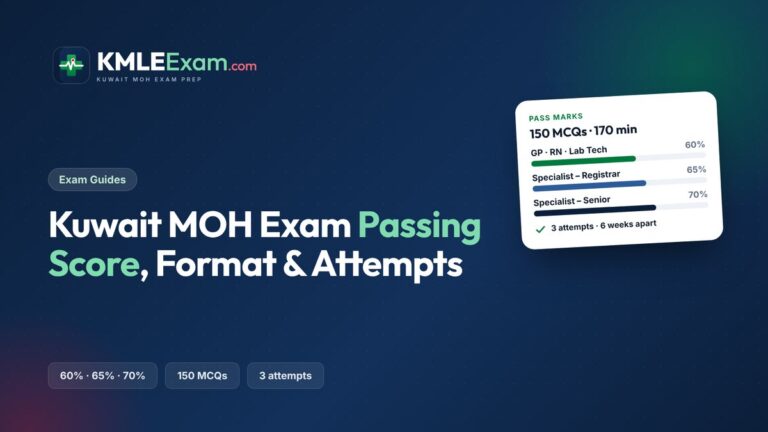
- Pass marks: 60% for GP, RN and Lab Technician; 65% Registrar / 70% Senior for specialist exams.
- Divide your study hours in proportion to the blueprint, then finish with timed practice.
What is the Kuwait MOH exam?
The Medical Licensing Department of the Kuwait Ministry of Health uses a computer-based licensing exam delivered by Prometric at test centres worldwide. Prometric’s published document is titled “Kuwait Licensing Exam” and covers nine specialties. For each one it lists the sections, the number of questions per section, the time allowed, the number of attempts and the pass mark — and it notes that content, percentages and attempts are subject to change on department review (Prometric “Kuwait Licensing Exam” document).
If your specialty is not one of the nine, start by confirming your exam category with the Ministry of Health. Our Kuwait MOH exam directory shows, for all 79 specialties, whether an official blueprint exists or how the specialty relates to one.

Step 1: weight your study time by the official blueprint
Because every exam has 150 questions, each question is worth about 0.67% of your score. A section with 30 questions is therefore worth five times as much as a section with six. Allocate your hours the same way. Three examples from the official blueprints:
| Exam | Largest sections (questions) | What that means for study time |
|---|---|---|
| General Practitioner | Medicine 45 · OB/GYN 38 · Pediatrics 37 · Surgery 30 | About 30% of your time on medicine, 25% each on OB/GYN and pediatrics, 20% on surgery |
| Internal Medicine | Infectious Diseases 17 · Cardiovascular 16 · Pulmonary 16 · Gastrointestinal 15 | Cover these four first; they make up 43% of the exam |
| Registered Nurse | Adult Nursing 60 · Maternal-Child 45 · Fundamentals 30 · Management 15 | Adult nursing alone is 40% — prioritise medical, surgical and critical-care nursing |
Patient Safety and Professionalism & Ethics appear in every specialist blueprint (4–8 questions each). They are quick to learn and easy marks.
Step 2: build a six-week plan
Take a mixed 50-question test, map your scores to the blueprint sections and fix your daily study time.
Work through the highest-weighted sections with topic-wise MCQs and full explanations.
Finish the smaller sections, then repeat every question you got wrong.
Two or three full 150-question mocks in 170 minutes, then light review and rest.
A sample study day
| Time | Activity | Goal |
|---|---|---|
| 10 min | Review yesterday’s error log | Reinforce weak points |
| 45 min | 30 MCQs from one blueprint section | Apply knowledge to scenarios |
| 25 min | Read every explanation, including why wrong options are wrong | Understand the reasoning |
| 10 min | Update your error log by section | Know what to revisit |
Step 3: practise at exam pace
You have 170 minutes for 150 questions — about 68 seconds per question (76 seconds in the 190-minute Anesthesia exam). In the final two weeks, practise in timed blocks at that pace. Answer what you know, flag what you don’t, and return to flagged questions at the end.
Common mistakes to avoid
- Confirm your exam category with MOH first
- Weight study time by the blueprint
- Read every explanation
- Do full timed mocks before the exam
- Make sure your ID name matches your booking
- Spend days on a 1-question subtopic
- Rely only on textbooks
- Ignore ethics and patient safety
- Memorise “recalled” questions
- Learn brand-new topics the night before
Frequently asked questions
How long should I study for the Kuwait MOH exam?
Most working professionals need 4–8 weeks at 60–90 minutes a day. Plan longer if you have been away from clinical practice or are sitting a broad exam such as General Practitioner.
How many questions are in the Kuwait MOH exam?
Each of the nine published exams has 150 multiple-choice questions.
How long is the exam?
170 minutes plus a 10-minute break; Anesthesia is 190 minutes plus a 10-minute break.
What is the passing score?
60% for General Practitioner, Registered Nurse and Lab Technician; 65% (Registrar) or 70% (Senior) for the specialist exams.
How many attempts do I get?
Three, at least six weeks apart. Ophthalmology allows two.
Should I use recalled exam questions?
No. Recalled questions are unreliable and may breach exam rules. Practise with original questions written to the published blueprint.
Is there an official blueprint for every specialty?
No — only for nine exams. For other specialties, confirm your category with the Ministry of Health; our directory explains how each specialty relates to the official exams.
Which references should I use?
Prometric lists recommended references for each exam. Use current editions and current clinical guidelines alongside them.
Conclusion
The Kuwait MOH exam rewards candidates who study the blueprint rather than the rumour mill. Confirm your category, weight your hours by the official section counts, practise every day with explanations and finish with full timed mocks.
- Prometric “Kuwait Licensing Exam” document — official blueprints, format, attempts and pass marks
- Prometric Kuwait MOH page
- Information checked on 1 November 2026. Always confirm current rules with Kuwait MOH and Prometric.
Pass your Kuwait MOH exam with confidence
Join healthcare professionals preparing with exam-style questions built for the Kuwait MOH exam.
- Exam-style MCQs for 79 Kuwait MOH specialties
- Detailed explanations for every question
- Topic-wise practice on mobile, tablet and desktop
- Instant access after payment