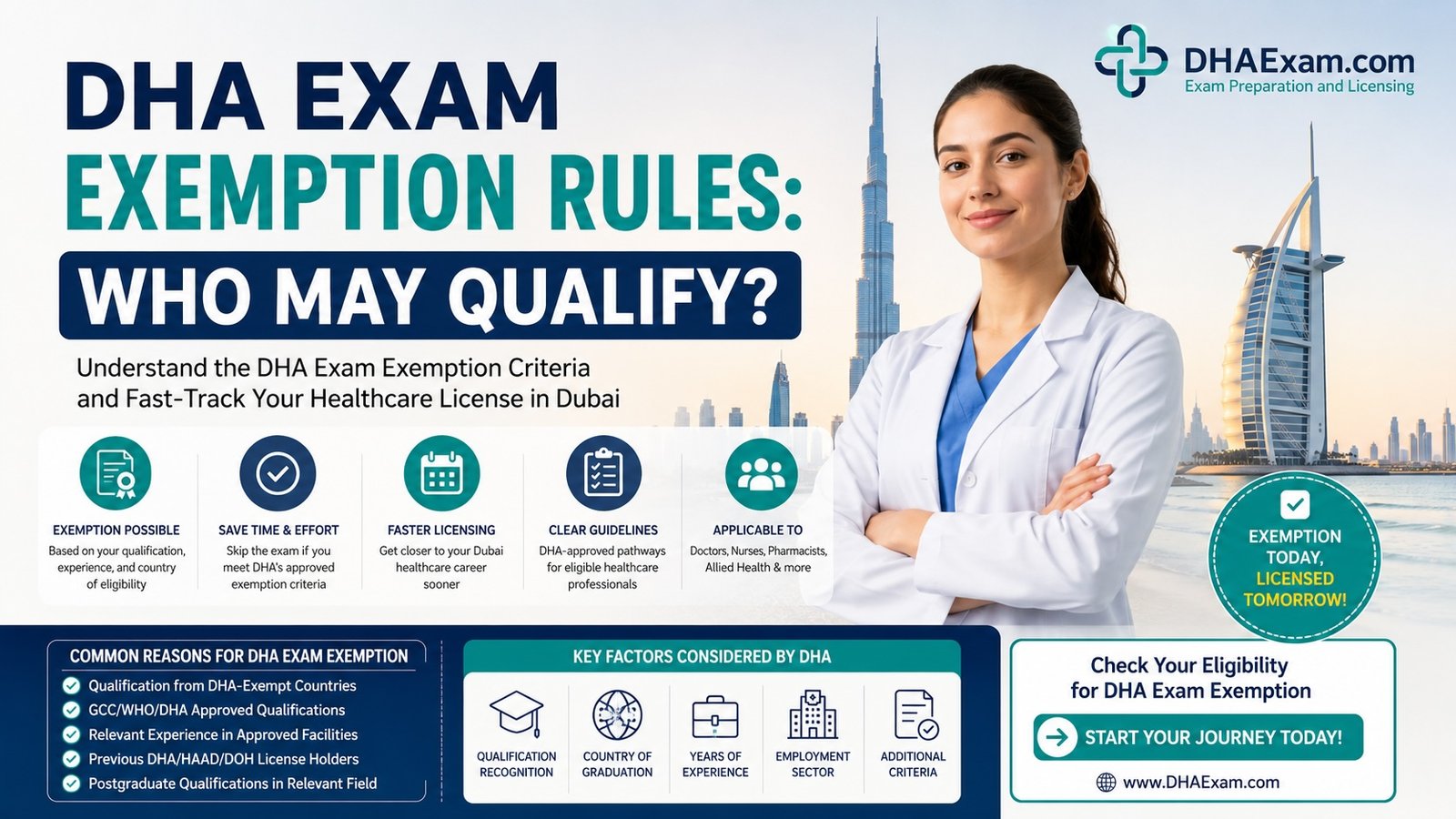
Many healthcare professionals searching for a DHA Exam exemption want a simple answer: “Can I avoid the DHA assessment and get licensed faster?” The honest answer is: maybe, but only if your qualification, registration, examination history, professional license, and practice status match DHA and UAE PQR rules.
Table of Contents
ToggleThe exemption is not a shortcut for unqualified applicants. It is an equivalency pathway for professionals who already meet specific recognized standards. In other words, the Dubai Health Authority may exempt some applicants from the assessment exam, but it does not exempt them from the wider licensing process.
This guide explains the main DHA assessment exemption rules in clear language, including who may qualify, who usually does not qualify, which documents matter, and what to do if you are unsure. It is especially useful for doctors, dentists, nurses, pharmacists, allied health professionals, and other applicants planning a DHA Exam preparation or DHA eligibility journey.
Need Help Checking DHA Exam Exemption?
If you are not sure whether you need the DHA Prometric exam or may qualify for exemption, review your category, qualification, license, good standing, and practice gap carefully before applying.
Key Takeaways About DHA Exam Exemption
- DHA Exam exemption is limited to the licensure assessment only. It does not remove credentialing, experience, PSV/DataFlow, professional license, or good standing requirements.
- Some UAE nationals and children of Emirati women may be exempted from authority examinations under the PQR, subject to evidence and category conditions.
- Some international exams, licenses, registrations, or specialist qualifications may qualify under the UAE exam equivalency criteria.
- Professional title must match. Your recognized exam or license must support the same title you are requesting in Dubai.
- Gap of practice can affect exemption. Applicants with long discontinuity of practice may still need to complete additional requirements and may be required to pass an assessment.
What Is DHA Exam Exemption?
DHA Exam exemption means that a healthcare professional may not be required to take the DHA licensure assessment, such as the Prometric CBT or oral assessment, because they meet recognized equivalency criteria.
This is usually called exam equivalency, assessment exemption, or professional assessment exemption. It may apply when an applicant has successfully completed certain recognized international examinations or holds an active registration or license from specific regulatory bodies.
However, the exemption is not the same as getting a direct license. Applicants still need to go through the Sheryan process, submit documents, complete verification where applicable, and meet the Professional Qualification Requirements.
What DHA Exam Exemption Does Not Cover
One of the biggest mistakes applicants make is thinking that exemption means “no application process.” That is incorrect. Even if you qualify for a DHA license exemption from the exam, you may still need:
- Recognized educational qualifications
- Valid professional license or registration
- Good Standing Certificate
- Relevant clinical experience
- Primary Source Verification through DataFlow or the approved verification agency
- Sheryan application review
- Employer activation for the final professional license
DHA Exam Exemption vs DHA License Exemption
These two terms are often confused. A DHA Exam exemption relates to the assessment. A DHA license exemption is not a general automatic waiver from licensing. To work legally in Dubai, healthcare professionals must still hold an active DHA professional license or valid registration pathway.
| Term | Meaning | Important Note |
|---|---|---|
| DHA Exam Exemption | You may not need to sit the DHA assessment exam. | You still need to meet licensing requirements. |
| DHA Assessment Exemption | Another term for exemption from CBT/oral assessment. | Depends on PQR equivalency criteria. |
| DHA Professional License | Final approval to practice in a DHA-licensed facility. | Usually activated by an eligible employer in Dubai. |
Who May Qualify for DHA Assessment Exemption?
Eligibility depends on the professional category and the exact title requested. DHA and UAE PQR rules do not treat every applicant the same. A general practitioner, specialist physician, consultant dentist, nurse, pharmacist, physiotherapist, radiographer, and dental hygienist can all have different equivalency requirements.
1. UAE Nationals and Children of Emirati Women
Under UAE PQR rules, UAE nationals and children of Emirati women may be exempted from authority examinations. Children of Emirati women usually need to provide supporting documents, such as a birth certificate and the mother’s family book, where required.
This does not mean every other requirement disappears. The applicant must still follow the relevant licensing path, provide documents, and meet category-specific requirements.
2. Applicants With Recognized International Examinations
Some applicants may qualify for DHA professional assessment exemption if they have passed recognized international licensing or equivalency examinations. Examples may include certain examinations from countries such as the USA, UK, Canada, Australia, New Zealand, Ireland, and other listed jurisdictions, depending on the profession and title.
For example, some general practitioner pathways may recognize examinations such as PLAB, USMLE Step/Part III, LMCC, AMC, NZREX, or other listed equivalents where the PQR criteria are satisfied. For dental, nursing, pharmacy, medical imaging, physiotherapy, laboratory, and other allied health titles, the accepted examinations or registrations can be different.
3. Applicants With Valid Registration or License From Recognized Authorities
For several nursing and allied healthcare titles, a valid license and Good Standing Certificate from listed countries or regulatory bodies may support exemption, provided the qualification timing and gap of practice conditions are met.
This is why applicants must not assume exemption based only on nationality of education. The authority may look at your qualification, license, registration body, recent practice, English language evidence, and whether your requested DHA title matches your existing professional status.
4. Specialist and Consultant Applicants With Recognized Qualifications
Specialist and consultant physicians or dentists may have different exemption rules based on recognized certificates, country tiers, higher specialty training, seniority, active license, good conduct, and professional history. The title requested matters greatly.
A qualification that helps one applicant qualify for a specialist title may not automatically qualify another applicant for a consultant title. When in doubt, use the DHA Exam eligibility guide and Sheryan review pathway before booking any exam.
Important Conditions for Healthcare License Exemption in Dubai
Before depending on a healthcare license exemption Dubai pathway, review these conditions carefully.
| Condition | Why It Matters |
|---|---|
| Professional title match | Your equivalent exam, license, or certificate must match the DHA title you request. |
| Valid evidence | Pass records, licenses, and certificates must be valid and verifiable. |
| Gap of practice | A practice gap above the allowed limit can affect exemption and may trigger extra requirements. |
| Good standing | Regulators need evidence that the applicant is professionally fit to practice. |
| Primary Source Verification | DHA may still require verification of education, experience, license, or other documents. |
Documents Commonly Needed for DHA Exam Exemption Review
The exact documents depend on your profession and Sheryan application. However, applicants should usually prepare a strong file before requesting review.
- Passport copy
- Recent passport-size photograph
- Educational certificates and transcripts
- Internship certificate, where applicable
- Experience certificates
- Current or previous professional license
- Good Standing Certificate
- Recognized international exam pass proof, if claiming exam equivalency
- Specialty certificate or board certificate, if applicable
- English language evidence, where required by category
- DataFlow or Primary Source Verification documents
For help with document verification, read our DHA DataFlow verification guide. For test preparation, see DHA Exam preparation packages.
How to Apply for DHA Exam Exemption Through Sheryan
The practical route is through the DHA Sheryan system. The applicant creates a profile, checks the relevant title, completes self-assessment or review, uploads documents, and follows the application result.
- Create or log in to your Sheryan account.
- Select your professional category and title. Make sure the title is accurate.
- Use the Self Assessment Tool. This helps you understand whether your profile meets the PQR pathway.
- Submit Review Registration Eligibility if needed. This is useful if you disagree with the self-assessment result or need manual review.
- Upload exemption evidence. Include recognized exam pass records, licenses, good standing, and relevant certificates.
- Complete PSV/DataFlow if requested.
- Wait for DHA review. DHA may accept, reject, request more documents, or require assessment.
- Proceed with registration or exam depending on the outcome.
Not Eligible for Exemption?
Do not worry. Many successful DHA-licensed professionals passed through the exam route. Use focused MCQs, mock tests, and exam-day preparation to improve your chances.
Common Reasons DHA Exam Exemption May Be Rejected
Exemption rejection can happen even when the applicant is experienced. The most common reasons are documentation gaps, title mismatch, outdated evidence, practice gaps, or misunderstanding the equivalency rules.
Title Mismatch
If your recognized exam or license supports one professional title but you apply for a different title, DHA may require assessment or further review.
Expired or Unclear Evidence
Some equivalency examinations must be valid at the time of application. If no validity is stated, accepted evidence may be limited by the rules. Documents should be clear, verifiable, and consistent.
Gap of Practice
A long gap from clinical practice can reduce or remove exemption benefit. Applicants with discontinuity may need CME/CPD, training, or even assessment depending on the case.
Incomplete PSV or Good Standing
Even if exam equivalency is valid, the application can be delayed or rejected if license, experience, or good standing cannot be verified.
Should You Prepare for the DHA Exam Even If You May Be Exempt?
Yes, at least lightly. Until the authority confirms exemption, you should not assume it is approved. Applicants who wait too long may lose valuable preparation time if DHA later requires the exam.
A practical approach is to prepare in parallel while your application is under review. Doctors can explore DHA GP exam questions, dentists can review DHA dental exam questions, nurses can use DHA nursing exam questions, pharmacists can study DHA pharmacist exam questions, and allied health professionals can check DHA allied health exam resources.
DHA Exam Exemption Checklist
- Have you selected the correct DHA professional title?
- Does your international exam, license, or certificate match that title?
- Is your license active or recently valid?
- Do you have a recent Good Standing Certificate?
- Can your documents pass Primary Source Verification?
- Do you have any gap of practice above three years?
- Do you need English language evidence for your category?
- Have you checked the latest PQR and Sheryan requirements?
- Are you ready to take the exam if exemption is not granted?
FAQs About DHA Exam Exemption
DHA Exam exemption means an applicant may not need to sit the DHA professional assessment because their recognized exam, license, registration, or qualification meets equivalency criteria. It only applies to the assessment requirement, not to the full licensing process.
No. You cannot work as a healthcare professional in Dubai simply because you believe you are exempt from the exam. You still need DHA registration or license activation through the proper Sheryan process and an eligible DHA-licensed facility.
Applicants most likely to qualify are those with recognized international exams, active licenses from listed regulatory bodies, eligible specialist or consultant qualifications, or special categories such as UAE nationals and children of Emirati women. Final decisions depend on the applied title and documentation.
UAE nationals and children of Emirati women may be exempted from authority examinations according to the PQR, but they still need to meet licensing, qualification, documentation, and Sheryan requirements.
In many cases, yes. Exam exemption does not automatically remove Primary Source Verification. DHA may still require verification of education, experience, license, good standing, or other documents.
Some nurses and midwives may qualify if they hold valid licenses and good standing from listed countries or have recognized examination evidence such as NCLEX, depending on exact conditions. They should confirm through Sheryan because nursing categories and license histories can vary.
Some pharmacists may qualify through recognized licenses or registration bodies from listed countries, and certain UAE residency entry examination evidence may also be relevant. However, the applicant must still meet title, qualification, practice, and document requirements.
If DHA does not approve the exemption, the applicant may need to complete the normal assessment route, such as CBT or oral assessment depending on category. This is why it is smart to keep preparing with mock tests while waiting for review.
Not always. UAE licensure recognition and transfer rules depend on current status, title, experience, good standing, and whether the professional meets the latest requirements. Applicants should not assume automatic approval without Sheryan confirmation.
The safest route is to use the DHA Sheryan Self Assessment Tool and, if needed, apply for Review Registration Eligibility. This allows DHA to evaluate your profile against the latest Professional Qualification Requirements.
Conclusion: DHA Exam Exemption Is Helpful, But It Must Be Verified
DHA Exam exemption can save time for eligible healthcare professionals, but it is not automatic and it does not replace the licensing process. The exemption is limited to the professional assessment and depends on recognized equivalency criteria, title match, valid documents, practice history, and DHA review.
If you are confident that you may qualify, prepare your documents carefully and submit the correct evidence through Sheryan. If you are unsure, do not wait until the last minute. Start basic revision, review your category, and keep your exam preparation ready in case the exemption is not granted.
For more guidance, explore DHA vs MOH vs DOH exam differences, DHA exam day checklist, and DHAExam.com preparation resources.
Prepare Smarter With DHAExam.com
Whether you qualify for exemption or need to take the DHA assessment, DHAExam.com helps healthcare professionals prepare with targeted MCQs, mock tests, exam guides, and licensing resources.
Disclaimer: DHA and UAE PQR rules can change. This article is for educational guidance only. Applicants should verify their case through official DHA Sheryan channels before making licensing decisions.