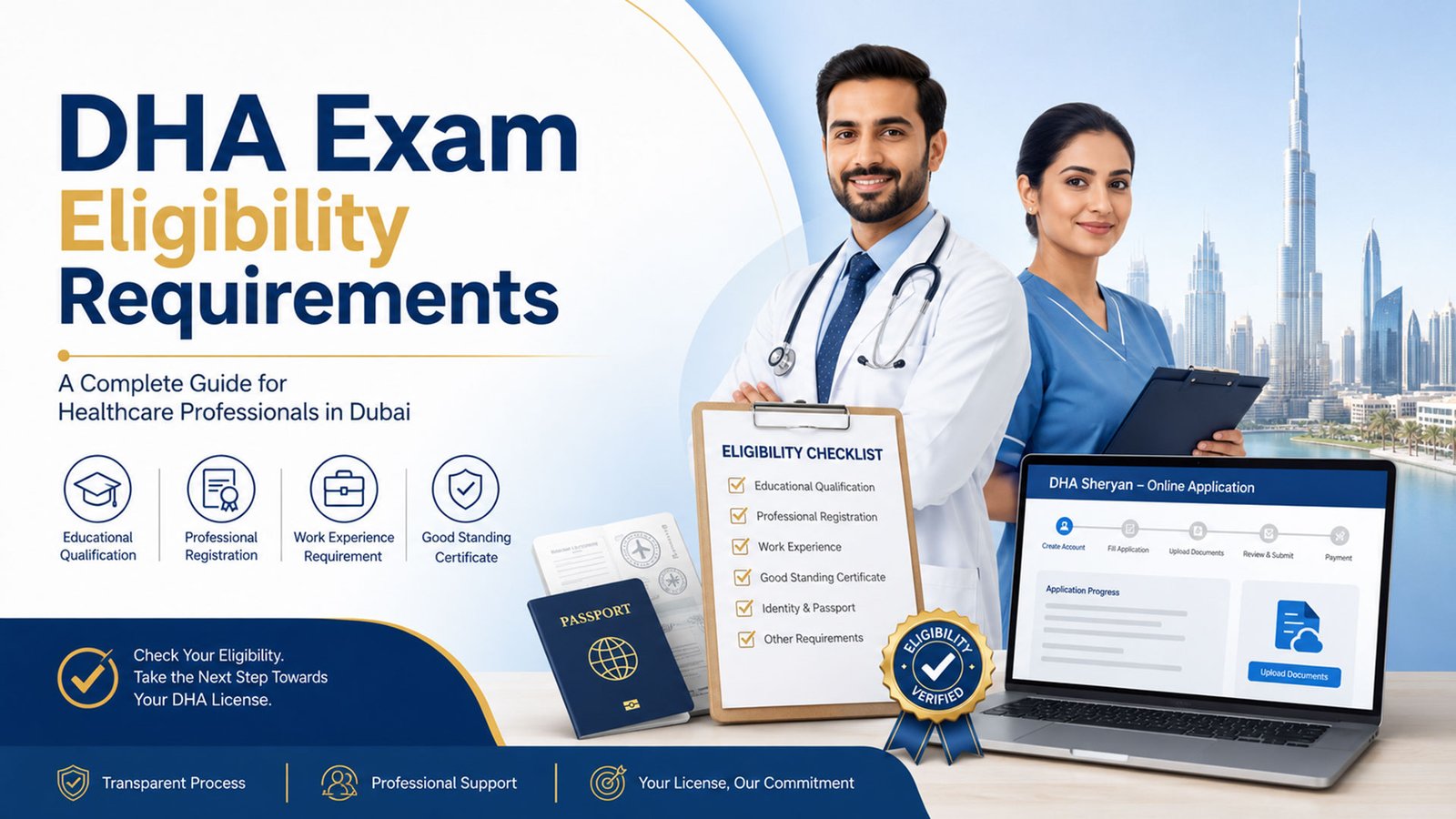
DHA Exam Eligibility Requirements for Dubai License
DHA Exam eligibility is the first serious checkpoint for any doctor, nurse, pharmacist, dentist, or allied healthcare professional who wants to work in Dubai. This guide explains the requirements in simple language, so you can understand what DHA expects, prepare the right documents, avoid delays, and move confidently toward your DHA professional license.
Table of Contents
ToggleLast updated for current DHA/Sheryan guidance. Always verify final requirements in your Sheryan account before submission.
Key Takeaways for DHA Exam Eligibility
- DHA Exam eligibility is title-specific. You must apply under the correct professional category, title, and specialty in Sheryan.
- Your qualification, internship, experience, professional license, Good Standing Certificate, and DataFlow report all matter. One weak document can delay the entire process.
- The Sheryan application is not just a form. It is the official licensing pathway that checks Dubai healthcare eligibility against DHA professional requirements.
- Passing the DHA Exam does not automatically activate your license. Registration must usually be activated by a DHA-licensed healthcare facility before you start practicing.
- Preparation should start early. Once you understand the DHA exam criteria, use focused MCQs, mock tests, and topic-wise revision to improve your pass chance.
What Is DHA Exam Eligibility?
DHA Exam eligibility means you meet the minimum professional, educational, licensing, and experience standards required by the Dubai Health Authority pathway for the healthcare title you want to apply for. It is not a single universal rule. It changes according to your profession, specialty, qualification route, country of education, internship history, years of clinical work, license status, and selected title in the Sheryan portal.
For example, the eligibility profile of a General Practitioner is different from a Registered Nurse. A General Dentist is assessed differently from a Dental Hygienist. A Pharmacist does not follow the same exact pathway as a Physiotherapist. This is why applicants often feel confused when they read random online advice. One person may say, “You need two years of experience,” while another may say, “No experience is required.” Both statements can be true in different contexts, depending on the title and category.
In simple terms, DHA eligibility asks five important questions:
- Do you have an accepted healthcare qualification?
- Have you completed the required internship or training, if your profession requires it?
- Do you have the minimum relevant clinical experience for your selected title?
- Do you hold a valid professional license or registration where applicable?
- Can your documents be verified through Primary Source Verification, commonly known as DataFlow?
If the answer is yes, you can usually move forward in the DHA licensing journey. If the answer is unclear, you may need a manual eligibility review, additional documentation, or a corrected Sheryan application. The most important lesson is this: do not book exam preparation blindly before confirming the exact eligibility route for your title.
DHA Exam Eligibility vs DHA License Eligibility
Many applicants mix up DHA Exam eligibility and DHA professional license eligibility. They are connected, but they are not identical. DHA Exam eligibility generally means you are allowed to proceed with the required assessment for your title. DHA professional license eligibility is broader. It includes registration, document verification, good standing, exam or assessment completion, and final license activation through an approved facility.
Think of it like this:
- Eligibility check: “Do I meet the minimum requirements to apply?”
- DataFlow/PSV: “Are my documents genuine and verifiable?”
- DHA Exam/assessment: “Do I meet the knowledge standard for this professional title?”
- DHA registration: “Am I approved to be added to Dubai Medical Registry?”
- License activation: “Can I legally practice under a DHA-licensed facility?”
This distinction matters because passing the exam alone does not automatically mean you can start work. A healthcare facility generally needs to activate your registration into a professional license before you practice in Dubai.
Need DHA Exam MCQs After Eligibility?
Once your eligibility route is clear, do not waste time with random notes. Use structured DHA MCQs, mock exams, and topic-wise revision. Visit DHA Exam Preparation to choose the right practice package for your profession.
Why DHA Exam Eligibility Matters Before You Start Preparation
Many healthcare professionals start by searching for “DHA exam questions” or “DHA MCQs” before checking their eligibility. Preparation is important, but eligibility comes first. If your selected title is wrong, your experience letter does not match your job duties, your Good Standing Certificate is outdated, or your degree cannot be verified, your exam plan can be delayed.
The smarter approach is to treat DHA eligibility as the foundation of your Dubai career plan. When your foundation is clear, exam preparation becomes more focused. You know your title, your likely exam type, the expected scope of questions, the documentation you need, and the mistakes you must avoid.
Eligibility protects your time and money
Applying for a Dubai healthcare license can involve fees, document preparation, verification charges, exam booking costs, travel planning, and months of career decisions. A weak application can lead to insufficiency requests, manual reviews, rejected applications, delayed job offers, or repeated exam stress. Understanding the DHA exam criteria early helps you avoid unnecessary expense.
Eligibility helps you choose the correct exam category
Every healthcare professional wants the best possible title, but DHA does not assess ambition; it assesses evidence. You may be experienced in one department, but if your qualification, license, and experience do not support the title you selected, your application may not move forward. For example, a specialist title normally requires recognized specialty qualifications and relevant specialty experience. A general title may require a different combination of internship and clinical work.
Eligibility improves your exam preparation plan
Once your title is clear, your study becomes easier. A nurse preparing for a Registered Nurse exam should not revise like a specialist physician. A pharmacist should not follow a dental exam plan. A physiotherapist should focus on rehabilitation, anatomy, assessment, clinical conditions, and professional practice areas relevant to physiotherapy. Eligibility tells you what exam you are preparing for, and that helps you select the right MCQs and mock tests.
Core DHA License Requirements for Healthcare Professionals
The exact DHA license requirements depend on your profession, but most applicants are assessed through a group of core standards. These standards are used to decide whether your profile fits the role you want to practice in Dubai.
1. Recognized educational qualification
Your degree, diploma, or professional qualification must be relevant to the healthcare title you apply for. A recognized qualification is not only about having a certificate. DHA may look at the type of institution, course duration, mode of study, specialty recognition, and whether the qualification matches the scope of practice.
For physicians, DHA’s professional qualification framework refers to formal recognized medical schools and medical degree requirements. For nurses, recognized nursing college or university qualifications are important. For pharmacists, pharmacy degrees and qualification routes matter. Allied health titles often have very specific degree or diploma requirements, such as physiotherapy, medical laboratory science, radiography, anesthesia technology, clinical nutrition, and other disciplines.
2. Internship or clinical training
Some professions require internship or post-graduation training. Physicians and dentists commonly need to show completion of internship. For certain nurse, midwife, and allied health applicants, post-graduation clinical training may apply depending on nationality, UAE graduation status, and title. The key point is simple: if your profession requires internship or training, keep the certificate clear, official, and consistent with your graduation timeline.
3. Relevant professional experience
Experience must usually be relevant to the title. A generic employment letter may not be enough if it does not show your designation, department, duration, working hours, and clinical responsibilities. For many titles, DHA is interested in post-qualification or post-internship experience, not just any healthcare-related work.
For example, a General Practitioner pathway can involve medical degree, internship, and clinical experience requirements. General Dentist pathways also commonly involve internship and clinical experience. Many allied health and pharmacy titles require experience in the related field. However, there are exceptions and special considerations, so applicants should not rely on a single rule copied from another profession.
4. Valid professional license or registration
Where applicable, applicants should hold a valid license or registration to practice in their home country or country of last employment. The license should be connected to the period of experience you are claiming. A common mistake is submitting experience from a period when the professional license was expired, inactive, or not yet issued. This can create questions during review.
5. Good Standing Certificate
A Good Standing Certificate, sometimes called a Certificate of Good Standing or GSC, supports that you are not restricted or prohibited from professional practice by the relevant regulatory body. It should be recent and issued by the correct authority whenever possible. If your country does not have a regulatory body, the official requirement may allow alternative evidence from the last employer in certain situations, but applicants should verify this carefully before submission.
6. Primary Source Verification by DataFlow
DHA uses Primary Source Verification to verify the authenticity of key documents. This process is commonly completed through DataFlow. Your education, license, and experience documents may be checked directly with the issuing institutions. If an institution does not respond, if your name differs across documents, or if an uploaded scan is unclear, the verification may be delayed or become negative.
7. Passing the required assessment
Many healthcare professionals are required to pass a DHA assessment, often a computer-based test through Prometric, although assessment mode can differ by title. Some categories may require oral assessment or other formats. Some applicants may qualify for exam exemption under specific recognition or equivalency criteria, but exemption should never be assumed without official confirmation.
Profession-Wise Dubai Healthcare Eligibility Overview
The following overview is designed to help beginners understand how Dubai healthcare eligibility differs by profession. It is not a replacement for the official Sheryan/PQR assessment, but it will help you approach your application with the right mindset.
| Professional Category | Typical Eligibility Focus | Common Applicant Risk | Preparation Tip |
|---|---|---|---|
| Physicians / Doctors | Medical degree, internship, clinical experience, specialty qualification if applying as specialist or consultant, valid license, GSC, PSV, exam or assessment. | Applying for a higher title without recognized specialty qualification or sufficient post-specialty experience. | Confirm whether you are applying as GP, specialist, consultant, resident, or intern before choosing study material. |
| Dentists | BDS/DMD/DDS or equivalent, internship, clinical experience for general dentist, specialty certificate for specialist/consultant routes, license, GSC, PSV. | Missing internship certificate or weak specialty documentation. | Prepare general dentistry fundamentals plus clinical decision-making and ethics. |
| Nurses and Midwives | Recognized nursing qualification, valid license where applicable, BLS where relevant, transcript, PSV, title-specific requirements. | Confusion between Registered Nurse, Assistant Nurse, Specialty Nurse, and Nurse Practitioner routes. | Use role-specific nursing MCQs and revise adult health, maternal-child, emergency, infection control, and patient safety. |
| Pharmacists | Pharmacy qualification, relevant experience for pharmacist or pharmacy technician routes, license, GSC, PSV, exam. | Submitting sales or pharmaceutical company experience where clinical or related field experience is required. | Focus on pharmacology, calculations, dispensing, counseling, safety, and UAE practice expectations. |
| Allied Health Professionals | Title-specific degree/diploma, relevant experience, license or registration where applicable, PSV, exam or oral assessment. | Choosing a title that does not match exact qualification wording or scope of experience. | Match your MCQs to the exact allied specialty, such as physiotherapy, lab, radiography, anesthesia, dietetics, or respiratory therapy. |
DHA eligibility for doctors
Doctors should pay close attention to degree recognition, internship, clinical experience, license status, and the exact title. A General Practitioner route is not the same as a Specialist or Consultant route. Specialist and Consultant pathways depend heavily on the recognized specialty certificate, tier, and post-qualification experience. Doctors should also ensure that the clinical experience is in a setting and specialty relevant to the title selected.
For doctors planning to apply as General Practitioners, the experience must support general medical practice. For specialist applicants, the application should clearly show specialty qualification and relevant post-specialty practice. For consultant applicants, the requirements are usually more demanding. A doctor with years of experience but without the required recognized qualification may still face eligibility issues.
DHA eligibility for nurses
Nursing applicants should first identify the correct title. Registered Nurse, Assistant Nurse, Specialty Nurse, Nurse Practitioner, Midwife, and Assistant Midwife are not interchangeable. Each title has its own qualification and practice expectations. A nursing degree, transcript, license, BLS certificate, experience records, and DataFlow verification can all be important.
A common nursing mistake is assuming that all nursing experience is treated the same. DHA may consider whether the experience aligns with the title. If you are applying for a specialty route, your evidence should show specialty duties, relevant department work, and appropriate training or qualification.
DHA eligibility for dentists
Dentists should organize their degree, internship, license, clinical experience, and Good Standing Certificate carefully. For general dentist pathways, internship and clinical experience can be central. For specialist dentist pathways, the recognized specialty certificate and relevant experience are major factors. Dentists applying for privileges or specialty practice should be especially careful with logbooks, case records, and scope-related documentation where required.
DHA eligibility for pharmacists
Pharmacists need to confirm whether they are applying as Pharmacist, Clinical Pharmacist, Specialized Pharmacist, or Pharmacy Technician. Each route has specific qualification and experience expectations. For standard pharmacist pathways, relevant pharmacy experience is important. DHA guidance also indicates that experience as pharmaceutical company sales representatives may not be accepted for pharmacy licensing purposes, so applicants should review their experience letters carefully.
DHA eligibility for allied health professionals
Allied health is a large category. It includes physiotherapists, medical laboratory professionals, radiographers, anesthesia technologists, respiratory therapists, dietitians, optometrists, speech therapists, dental hygienists, and many others. Because there are many titles, this is where applicants often make mistakes. The title must match the qualification. A diploma route may be accepted for one title but not another. A bachelor’s degree may be required for a technologist route. Experience may need to be directly related to the clinical specialty.
Sheryan Application: How the DHA Eligibility Process Works
The Sheryan application is the main online pathway used by healthcare professionals for DHA licensing services. It guides applicants through eligibility checking, verification, assessment, registration, and license activation. If you are planning to work in Dubai, Sheryan is not optional; it is where your professional profile is assessed and processed.
Step 1: Create or access your Sheryan account
Start by creating your profile with accurate personal details. Use the same name format that appears on your passport and professional documents. If you have name differences due to marriage, spelling variations, initials, or document translations, prepare official supporting documents early. Name mismatch is one of the easiest ways to delay DataFlow and eligibility review.
Step 2: Use the Self Assessment Tool
DHA provides a Self Assessment Tool that allows applicants to check whether they meet the Unified Healthcare Professional Requirements for working in a DHA-licensed healthcare facility. The result helps you understand whether your profile appears eligible for the selected title. If the result is not eligible, you may still have the option to request a review of your registration eligibility, but you should not treat that review as guaranteed approval.
Step 3: Select the correct professional category and title
This step is more important than many applicants realize. If you select the wrong title, your eligibility result may be inaccurate. A nurse should not choose a title based only on salary expectations. A doctor should not select specialist status without recognized specialty evidence. A pharmacist should not choose clinical pharmacist unless the qualification and experience support that route. The correct title should match your education, license, experience, and intended scope of practice.
Step 4: Complete Primary Source Verification
If your route requires Primary Source Verification, submit your documents through the approved verification process. DataFlow may verify your education, experience, license, or other credentials with the issuing sources. You should upload high-quality scans, provide accurate contact details for institutions, and respond quickly to any insufficiency request.
Step 5: Complete the DHA assessment if required
Many professionals must pass a computer-based test or another assessment. The assessment mode can depend on the profession and title. The official Sheryan guidance should always be checked because some titles may have oral assessments, CBT assessments, OSCE-style assessments, or assessment exemptions under specific conditions.
Step 6: Get registered
Once the professional requirements are met, the registration step confirms that the professional fulfills the requirements for the applied category, title, and specialty. Registration allows the professional to become part of the Dubai Medical Registry. This registration is typically not the same as an active practice license until a facility activates it.
Step 7: Activate the DHA professional license
To actually practice, the registration generally needs to be activated into a license by a DHA-licensed healthcare facility. This means a clinic, hospital, medical center, pharmacy, or healthcare institution in Dubai must complete the relevant activation process. Applicants should not resign from jobs or relocate without understanding this final step.
DataFlow, PSV, and DHA Exam Criteria
Primary Source Verification, commonly called DataFlow, is one of the most important parts of the DHA licensing journey. It checks whether your documents are genuine and whether they were issued by the institutions you claim. The DHA exam criteria are not only about academic knowledge; they also include documentary credibility.
What documents are commonly verified?
The exact verification package can vary, but applicants commonly need to verify documents such as:
- Degree, diploma, or professional qualification certificate
- Professional license or registration
- Employment or experience certificates
- Internship certificate, where applicable
- Specialty qualification, where applicable
- Additional documents requested by DHA or DataFlow
Why DataFlow delays happen
DataFlow delays usually happen for practical reasons. The issuing university may not respond quickly. A hospital may have changed its HR email. A licensing council may require a different verification process. Your certificate name may not match your passport. Your scanned copy may be unclear. Your experience letter may lack dates, designation, or official stamp. These issues are common, but many can be avoided with preparation.
How to reduce verification risk
Before submitting, create a document folder and review every file like an officer would. Ask yourself:
- Is the document clear, complete, and readable?
- Does the name match my passport or do I need a name-change proof?
- Does the experience letter show exact start and end dates?
- Does the employer letter mention designation and department?
- Is the license valid and connected to my claimed experience?
- Do I have official translations if the document is not in English or Arabic?
- Can the issuing authority be contacted for verification?
Important note on timelines and fees
Processing times, fees, and document rules can change. Always check your own Sheryan portal and DataFlow application before payment. Do not rely only on WhatsApp groups or old screenshots because DHA and DataFlow processes may update.
DHA Eligibility Documents Checklist
Documents are the backbone of your eligibility application. A strong profile can still face delays if the documents are incomplete. Use the checklist below before starting your Sheryan application.
Basic personal documents
- Valid passport copy
- Recent passport-size photograph
- Emirates ID, if already available
- UAE visa or residence page, if applicable
- Name-change document, if your documents show different names
Education and training documents
- Degree, diploma, or professional qualification certificate
- Academic transcript, especially where required for credentialing
- Internship completion certificate for physicians and dentists where required
- Postgraduate specialty certificate, if applying for specialist or consultant route
- Clinical training certificate, fellowship certificate, or residency certificate if relevant
Professional practice documents
- Professional license or registration from home country or last employment country
- Good Standing Certificate from the relevant regulator or acceptable issuing authority
- Experience letters from employers with dates, title, department, and duties
- Logbook for surgical specialties or procedure-based roles, if requested
- BLS, ACLS, PALS, or other certificates if required for your scope
Document formatting tips
Upload only clear, high-resolution scans. Avoid cropped certificates, shadows, mobile photos with glare, missing back pages, or unreadable stamps. If your document is not in English or Arabic, arrange official translation. Keep file names professional, such as Passport_Sheraz_Akhtar.pdf or Experience_Hospital_Name_2021_2024.pdf. Organized documents create fewer mistakes during application.
Common DHA Exam Eligibility Mistakes and How to Avoid Them
Many rejected or delayed applications are not caused by lack of qualification. They happen because the applicant submits the wrong title, weak documents, mismatched dates, or incomplete evidence. Here are the mistakes you should avoid.
Mistake 1: Choosing the wrong title in Sheryan
This is the most serious mistake. Your title determines the requirements. If you choose the wrong title, the system may assess you against standards you do not meet. Before submitting, compare your qualification, license, and experience with the title you selected.
Mistake 2: Counting experience incorrectly
Experience is not always counted from the day you started working. For some routes, experience may need to be after internship, after qualification, after license, or after specialty certification. If your dates are unclear, DHA may not accept the full period. Make sure your experience letters clearly show the timeline.
Mistake 3: Submitting outdated Good Standing Certificate
A GSC should generally be recent. If you upload an old certificate, you may receive an insufficiency request or delay. Apply for the GSC at the right time so it remains valid during your submission window.
Mistake 4: Using unclear experience letters
An experience letter that says only “worked in our hospital” is weak. It should show your name, job title, department, employment dates, full-time or part-time status, official letterhead, stamp, signature, and contact information. If your job duties are relevant to your title, ask HR to mention them clearly.
Mistake 5: Ignoring name mismatch
If one document uses initials, another uses full name, and another has a spelling variation, DataFlow may question it. Prepare name affidavits, marriage certificates, passport pages, or official supporting documents where needed.
Mistake 6: Assuming exam exemption without confirmation
Some applicants may be exempt from assessment under specific criteria, but exemption is not automatic. Always rely on official confirmation through the Sheryan pathway. Preparing for the exam is safer than assuming exemption based on someone else’s case.
Mistake 7: Waiting until eligibility is approved to begin studying
You should not book blindly, but you also should not wait too long to study. Once your likely title is clear and documents are under process, begin structured revision. DHA exams are competitive, and strong MCQ practice can make a big difference.
What to Do After You Meet DHA Exam Eligibility
Once your eligibility pathway is clear, it is time to move from document planning to exam planning. This is where many applicants lose focus. They download random PDF files, join too many groups, revise unrelated notes, and waste time on old question banks. A better plan is simple, structured, and measurable.
Build a 30-day DHA preparation routine
If your exam is close, use a 30-day plan:
- Days 1–5: Review exam pattern, weak topics, and core syllabus areas.
- Days 6–15: Practice topic-wise MCQs and revise explanations.
- Days 16–23: Start timed mock tests and analyze mistakes.
- Days 24–28: Revise high-yield notes, guidelines, formulas, and safety topics.
- Days 29–30: Do light review, rest properly, and avoid panic learning.
Use MCQs the right way
MCQs are not only for testing memory. They train your clinical reasoning, improve exam speed, and show repeated patterns. When you get a question wrong, do not only memorize the correct option. Ask why the other options were wrong. That habit improves performance in new questions.
Track your mock test score
Keep a simple score sheet. Write the date, topic, number of questions, percentage score, and weak areas. If your score is not improving, change the method. Do not repeat the same MCQs without understanding explanations. For exam readiness, consistency matters more than last-minute stress.
Prepare With DHAExam.com
Ready to move from eligibility to exam success? Explore DHA exam preparation packages, topic-wise MCQs, and mock exams designed for healthcare professionals applying for Dubai licensing.
Media Suggestions for This Blog Post
Recommended featured image
Use a high-quality image of a healthcare professional reviewing documents with a Dubai skyline or medical licensing theme in the background.
Suggested alt text: “Healthcare professional checking DHA Exam eligibility requirements for Dubai license application”
Recommended infographic
Create a simple vertical infographic titled “DHA Exam Eligibility Process in 7 Steps” showing: Sheryan account, self-assessment, document preparation, DataFlow, DHA assessment, registration, license activation.
Suggested alt text: “DHA Exam eligibility process from Sheryan self assessment to professional license activation”
Recommended video
Add a 3–5 minute explainer video answering: “Am I eligible for the DHA Exam?” Include examples for doctors, nurses, dentists, pharmacists, and allied health professionals. Embed it near the top of the article to improve time on page.
Frequently Asked Questions About DHA Exam Eligibility
A healthcare professional may be eligible for the DHA Exam if they meet the educational, training, experience, license, good standing, and verification requirements for their selected professional title. This can include doctors, dentists, nurses, midwives, pharmacists, and allied health professionals. The key point is that eligibility is not general; it is title-specific.
You must select the correct category in Sheryan and ensure your qualification and experience match that title. For example, eligibility for a Registered Nurse is different from eligibility for a Specialty Nurse. Eligibility for a General Practitioner is different from eligibility for a Specialist Physician. Always check your title carefully before submitting the application.
The basic DHA license requirements usually include a recognized qualification, relevant internship or training where required, professional experience matching the title, a valid professional license or registration where applicable, a Good Standing Certificate, Primary Source Verification, and passing the required assessment.
After registration, the professional license normally needs to be activated by a DHA-licensed healthcare facility before practice begins. The exact requirements vary by profession, so applicants should avoid using a single checklist for all categories. A pharmacist, physiotherapist, dentist, and physician may all need different evidence.
Yes. The Sheryan application is the official online pathway for DHA professional licensing services. It is where applicants check eligibility, submit applications, connect with verification and assessment steps, and receive registration services.
Healthcare professionals should not treat Sheryan as a simple upload portal. It is the system that connects your profile, selected title, documents, assessment route, and licensing status. If you select the wrong title or enter incorrect details, your eligibility result may be affected.
It depends on your professional title, nationality category, education route, and the specific DHA requirements for that title. Some titles or applicant categories may have reduced or no experience requirements, while others clearly require post-qualification or post-internship experience.
For example, many general physician and dentist pathways involve internship plus clinical experience, while some nursing titles may have different rules. Do not assume you are eligible without experience simply because another applicant was accepted. Review the official pathway for your selected title.
DHA eligibility is the stage where your profile is assessed against requirements. DHA registration is a later stage that confirms the professional fulfills the requirements for the applied category, title, and specialty and allows the professional to become part of Dubai Medical Registry.
Registration is important, but it is still not always the same as an active license. To practice, a DHA-licensed facility usually needs to activate your registration into a professional license. This is why applicants should understand the full journey rather than focusing only on the exam.
Primary Source Verification is a core part of the DHA licensing pathway for many applicants. It verifies whether your submitted documents are genuine. DHA service guidance describes Primary Source Verification by DataFlow as part of the professional licensing process, and applicants may need a PSV result before completing later steps.
Because requirements may vary by application type and title, follow the instructions shown in your Sheryan account. Even if you can work on the exam and DataFlow in parallel, you should not ignore verification because a negative or incomplete report can delay licensing.
Common documents include passport copy, recent photograph, educational qualifications, experience certificates, professional license or registration, Good Standing Certificate, and logbook for surgical specialties where required.
Depending on the application type, Sheryan may request fewer or additional documents. Applicants should prepare all major documents before starting because missing files can cause delays. Keep official translations ready if your documents are not in English or Arabic. Also make sure every certificate is clear and complete before upload.
A Good Standing Certificate should normally be recent and valid at the time of application. DHA professional qualification guidance commonly refers to a certificate not older than six months at the time of applying for a license.
The GSC should ideally be issued by the health regulatory authority in the country of last employment or professional registration. If your country does not have a regulator, alternative evidence may be considered in some cases, but you should verify the requirement before relying on an employer letter.
An expired professional license can create eligibility problems, especially if it does not cover the experience period you are claiming. DHA guidance generally expects applicants to have valid professional license or registration where applicable. If your license expired recently, check whether your route allows any grace period or special handling. Do not hide license gaps. It is better to prepare a clear explanation and updated documentation than to submit inconsistent records.
Healthcare licensing authorities are usually strict about clinical qualifications because patient safety depends on proper training. For some categories, DHA professional qualification guidance indicates that qualifications acquired through honorary, correspondence, or distance-learning routes may not count toward requirements.
If your qualification involved online study, distance learning, blended learning, or non-traditional training, verify acceptance before paying application or verification fees. Clinical professions often require structured, recognized, supervised education and practical training.
DHA service guidance states that professionals must pass the related assessment within three attempts across the authorities. This is why applicants should take preparation seriously before booking. Do not use the first attempt as a trial.
Revise the exam content, practice timed MCQs, review weak areas, and take mock tests before the real exam. If you have already attempted licensing exams with another UAE authority, check how your attempt history affects your DHA route.
License recognition may be possible for healthcare professionals who fulfill the official requirements, hold a valid license from another authority, present a valid Good Standing Certificate, and complete the required Primary Source Verification as requested.
However, recognition is subject to conditions, title availability, exam attempt history, and each authority’s rules. If your previous license is expired, cancelled, suspended, or under restriction, the situation becomes more complex. Always check your exact case through the official pathway.
13. Can I apply for a higher title than my current license?
You can apply for the title you believe you qualify for, but DHA will assess evidence. If you currently work as a general practitioner but want a specialist title, you need recognized specialty qualification and relevant experience. If you are a pharmacist but want a clinical pharmacist title, your qualification and experience must support that route. Applying for a higher title without evidence can lead to delays or rejection. Choose the highest title you can prove, not simply the title you prefer.
14. What happens if Sheryan says I am not eligible?
If the Self Assessment Tool shows “not eligible,” it does not always mean the journey is permanently over. DHA guidance indicates that applicants may request a review registration eligibility of their qualifications. However, manual review is not a guarantee of approval. Before requesting review, identify why the system marked you as not eligible. It may be the wrong title, missing experience, qualification mismatch, incorrect dates, or a category selection error. Correct obvious mistakes before submitting a paid or formal review request.
15. Should I complete DataFlow before booking the DHA Exam?
DHA guidance states that DataFlow verification and CBT assessment may be performed in parallel where applicable. This can save time, but it also means you must manage risk. If you book and pass the exam but your DataFlow result later has a negative or unable-to-verify component, your licensing process may still be delayed. A balanced approach is to start DataFlow early and begin exam preparation at the same time. If your documents are complicated, wait for more clarity before booking the exam.
16. Do I need a job offer before applying for DHA Exam eligibility?
For many applicants, the initial eligibility, verification, assessment, and registration steps can be started before a final job offer. However, to activate a professional license and practice in Dubai, a DHA-licensed facility is usually involved. This means a job offer or hiring facility becomes important at the activation stage. Applicants should plan both sides: pass eligibility and exam requirements, but also prepare a CV, apply to Dubai healthcare facilities, and understand employer licensing responsibilities.
17. How long does DHA eligibility take?
The timeline depends on document readiness, DataFlow verification speed, assessment booking availability, Sheryan review time, and whether the application receives insufficiency requests. Some steps can be quick, while document verification can take longer if institutions are slow to respond. The best way to reduce delays is to prepare correct documents, provide working institutional contact details, avoid name mismatches, and respond quickly to DataFlow or DHA requests. Do not plan travel or resignation based on unofficial timelines.
18. What are the most common reasons for DHA eligibility delay?
Common reasons include wrong professional title selection, unclear certificates, missing internship, insufficient relevant experience, expired license, old Good Standing Certificate, name mismatch, incomplete employment letters, unresponsive issuing institutions, missing translations, and poor scan quality. Another major reason is copying another applicant’s pathway. Healthcare licensing is personal; your qualification, country, specialty, and experience dates matter. Build your application around your own evidence.
19. Is passing the DHA Exam enough to work in Dubai?
No. Passing the DHA Exam is a major achievement, but it is only one part of the licensing journey. You still need the required registration and license activation process before legally practicing. Your DataFlow report, eligibility approval, registration status, employer activation, and final license all matter. Many applicants celebrate after passing the exam, then feel confused when an employer asks for more steps. Understand the full licensing pathway from the beginning.
20. How can I prepare for the DHA Exam after eligibility approval?
Start with a focused study plan for your profession. Use topic-wise MCQs, timed mock tests, and explanation-based learning. Do not only memorize answers; understand clinical reasoning and why each wrong option is incorrect. Review patient safety, infection control, emergency care, ethics, calculations, and profession-specific guidelines. Track your mock scores weekly. If you are consistently weak in one area, revise that topic before taking more full tests. For structured practice, use DHAExam.com preparation resources to study with exam-focused MCQs.
You can apply for the title you believe you qualify for, but DHA will assess evidence. If you currently work as a general practitioner but want a specialist title, you need recognized specialty qualification and relevant experience.
If you are a pharmacist but want a clinical pharmacist title, your qualification and experience must support that route. Applying for a higher title without evidence can lead to delays or rejection. Choose the highest title you can prove, not simply the title you prefer.
If the Self Assessment Tool shows “not eligible,” it does not always mean the journey is permanently over. DHA guidance indicates that applicants may request a review registration eligibility of their qualifications. However, manual review is not a guarantee of approval.
Before requesting review, identify why the system marked you as not eligible. It may be the wrong title, missing experience, qualification mismatch, incorrect dates, or a category selection error. Correct obvious mistakes before submitting a paid or formal review request.
For many applicants, the initial eligibility, verification, assessment, and registration steps can be started before a final job offer. However, to activate a professional license and practice in Dubai, a DHA-licensed facility is usually involved.
This means a job offer or hiring facility becomes important at the activation stage. Applicants should plan both sides: pass eligibility and exam requirements, but also prepare a CV, apply to Dubai healthcare facilities, and understand employer licensing responsibilities.
The timeline depends on document readiness, DataFlow verification speed, assessment booking availability, Sheryan review time, and whether the application receives insufficiency requests.
Some steps can be quick, while document verification can take longer if institutions are slow to respond. The best way to reduce delays is to prepare correct documents, provide working institutional contact details, avoid name mismatches, and respond quickly to DataFlow or DHA requests.
Do not plan travel or resignation based on unofficial timelines.
Common reasons include wrong professional title selection, unclear certificates, missing internship, insufficient relevant experience, expired license, old Good Standing Certificate, name mismatch, incomplete employment letters, unresponsive issuing institutions, missing translations, and poor scan quality.
Another major reason is copying another applicant’s pathway. Healthcare licensing is personal; your qualification, country, specialty, and experience dates matter. Build your application around your own evidence.
Common reasons include wrong professional title selection, unclear certificates, missing internship, insufficient relevant experience, expired license, old Good Standing Certificate, name mismatch, incomplete employment letters, unresponsive issuing institutions, missing translations, and poor scan quality. Another major reason is copying another applicant’s pathway.
Healthcare licensing is personal; your qualification, No. Passing the DHA Exam is a major achievement, but it is only one part of the licensing journey. You still need the required registration and license activation process before legally practicing.
Your DataFlow report, eligibility approval, registration status, employer activation, and final license all matter. Many applicants celebrate after passing the exam, then feel confused when an employer asks for more steps. Understand the full licensing pathway from the beginning.
Start with a focused study plan for your profession. Use topic-wise MCQs, timed mock tests, and explanation-based learning. Do not only memorize answers; understand clinical reasoning and why each wrong option is incorrect.
Review patient safety, infection control, emergency care, ethics, calculations, and profession-specific guidelines. Track your mock scores weekly. If you are consistently weak in one area, revise that topic before taking more full tests. For structured practice, use DHAExam.com preparation resources to study with exam-focused MCQs.
Conclusion: Your DHA Eligibility Plan Starts With the Correct Title
DHA Exam eligibility is not difficult when you understand the logic behind it. Dubai wants healthcare professionals who are properly qualified, clinically experienced, licensed where required, in good standing, and able to verify their documents. The Sheryan application checks these details through a structured pathway. If you prepare early, choose the correct title, organize your documents, and study with the right MCQs, your journey becomes much smoother.
The most important takeaway is simple: do not treat DHA licensing as only an exam. It is a professional approval process. The exam is important, but so are your qualification, internship, experience, license, GSC, DataFlow, registration, and final license activation.
If you are at the beginning, start with eligibility. If your documents are ready, start DataFlow. If your title is clear, start exam preparation. If your registration is approved, start applying to DHA-licensed employers. Step by step, your Dubai healthcare career becomes achievable.
Ready to Prepare for Your DHA Exam?
Build your confidence with high-quality DHA MCQs, mock tests, and topic-wise practice. Visit DHAExam.com today, explore your profession-specific package, and start preparing with a clear plan.
Recommended next steps:
- Check your Sheryan eligibility for the correct title.
- Prepare your DataFlow documents before submission.
- Choose profession-specific MCQs and mock exams.
- Subscribe to DHAExam.com updates for licensing and preparation guides.